


A Visual Guide: Architectural Terms for Roof Styles

When visualizing a house, the roof is likely one of the first things that comes to mind. Roofs do more than provide shelter. The roof line is often indicative of a home's character, style and speaks to its vernacular.
During the Concept Phase of an architectural design project, it can be difficult to envision the ideal roof for your home. If you find yourself at a loss for words and start employing phrases such as "pointy" or "flat-ish", you're not alone.
This visual guide covers six common roof styles and their architectural terms, helping you clearly express your preferences more clearly during design.
Architectural Terms for Roof Styles
The Gable Roof: The Classic Triangle
The roof line you’ve seen most commonly in the United States is the “Gable Roof”. When you draw a “house” on a napkin (two lines with a triangle on top), that's a gable roof. It has two sloping sides meeting at a ridge, creating triangular wall ends.

Terms to Know:
Gable End: The triangular upper part of a wall, located between the edges of a roof that slopes on both sides.
Pitch: The pitch is how steep a roof is. A roof with a "high pitch" slopes sharply upward, helping snow slide off instead of piling up.
Ridge: The ridge is the highest line on the roof where two sloping sides join at the top.
The Hip Roof: Slopes on All Sides
A hip roof has no flat, vertical ends. All four sides slope downward toward the walls, making hip roofs sturdy and ideal for high-wind areas.
Hip: A hip is the outside corner or angle formed where two sloped parts of a roof meet.

Terms to Know
Eaves: The roof edges that overhang the walls. Hip roofs provide an overhang (eaves) around the entire house.
Soffit: The soffit is the surface or panel you see when you look up at the underside of the eaves from outside.
The Mansard Roof: The Parisian Classic
The mansard roof is associated with the French style and the Renaissance. It’s known for its four-sided roof with two slopes per side, and a lower slope is much steeper and frequently serves as an exterior wall for the top floor.

Terms to Know
Dormer: A structure (usually with a window) projecting vertically from the sloping roof. Dormers light upper-level spaces in mansard roofs.
Dual-Pitch: This means a roof has two different angles or slopes along its side, with a change in slope partway down.
The Gambrel Roof: The Barn Style
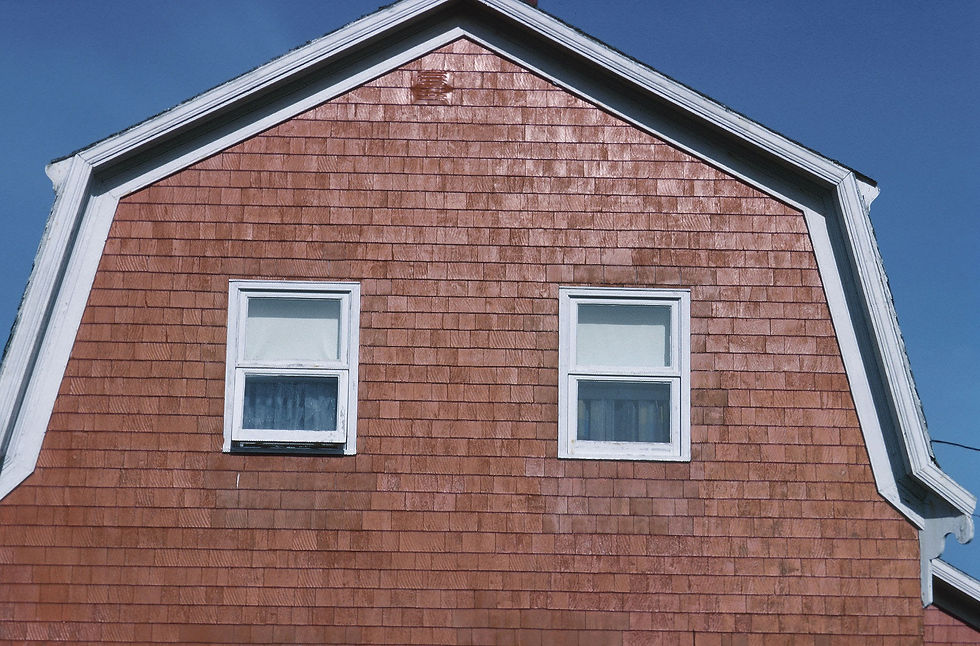
Often associated with classic barns and Dutch Colonial architecture, the gambrel roof is similar to the mansard roof, featuring two distinct slopes.
However, a gambrel roof only slopes on two sides, rather than four. It gives you the vertical benefits of a mansard roof without the complex four-sided framing.
Terms to Know:
Dutch Colonial: A style from 1600s America, known for broad, dual-pitched gambrel roofs maximizing attic space.
Fascia: The straight board along the roof's lower edge (often where gutters attach).
The Shed Roof: The Modern Lean-To
A shed roof (or skillion roof) is a single, sloping surface. Once for additions and sheds, it now defines modern homes.

Terms to Know:
Lean-To: A simple structure with one sloped roof. Shed roofs are large, stylized lean-tos.
Clerestory Windows: High-set windows, often just under the shed roof's highest point. They bring in light while protecting privacy.
The Flat Roof: The Contemporary Cube
A flat roof looks horizontal. It defines mid-century, Art Deco, and contemporary homes. Flat roofs are slightly sloped for drainage.

Terms to Know:
Membrane: Instead of traditional shingles, flat roofs are sealed with a continuous, waterproof membrane (such as EPDM rubber or TPO) to prevent water from pooling and leaking.
Parapet: A low protective wall along the edge of a roof. On many flat-roofed homes, the exterior walls extend slightly above the roofline, creating a parapet that hides the roof entirely from street level.


Comments